Fermi GBM Localizations
(gdt.missions.fermi.gbm.localization)
As part of mission operations, GBM produces localizations for GRBs and disseminates these to the community. GCN notices are sent to interested follow-up observers containing brief summary information, and HEALPix FITS files containing the localization are created and hosted at the Fermi Science Support Center. These localizations contain the best-modeled systematic uncertainty in the localization and contain a host of metadata such as the individual detector pointings and the geocenter location as observed by Fermi.
We can read one of these HEALPix files using the GbmHealPix class:
>>> from gdt.core import data_path
>>> from gdt.missions.fermi.gbm.localization import GbmHealPix
>>> filepath = data_path.joinpath('fermi-gbm/glg_healpix_all_bn190915240_v00.fit')
>>> loc = GbmHealPix.open(filepath)
>>> loc
<GbmHealPix: glg_healpix_all_bn190915240_v00.fit
 NSIDE=128; trigtime=590219102.911008;
 centroid=(48.8671875, 4.181528273111476)>
We can easily access some of the HEALPix-specific info (see also The HealPix Module for more details):
>>> loc.nside
128
>>> loc.npix
196608
>>> loc.pixel_area # (in sq. deg.)
0.20982341130279172
As for the localization information, we can retrieve the sky position with the highest probability (centroid):
>>> loc.centroid
(48.8671875, 4.181528273111476)
Or we can determine the probability of the localization at a particular point in the sky:
>>> loc.probability(49.0, 4.0)
0.009200396515918592
And if we want to determine the confidence level a particular point on the sky is relative to the localization:
>>> loc.confidence(40.0, 4.0)
0.865783539232832
Often for follow-up observations, it’s useful to know how much sky area the localization covers at a some confidence level:
>>> loc.area(0.9) # 90% confidence in units of sq. degrees
281.1633711457409
And for plotting or other purposes, we can retrieve the RA and Dec “paths” for a given confidence region.
Note
A confidence region may have many disjoint pieces, so this will be a list of arrays
>>> loc.confidence_region_path(0.5)
[array([[ 4.61281337e+01,  2.59721684e-01],
        [ 4.53138456e+01,  5.02793296e-01],
        [ 4.51253482e+01,  6.21222158e-01],
        ...
        [ 4.71309192e+01,  7.52679010e-02],
        [ 4.61281337e+01,  2.59721684e-01]])]
We can even determine the probability that a point source at a given location is association with the skymap (as opposed to the null hypothesis of two spatially-unrelated sources):
>>> loc.source_probability(50.0, 10.0)
0.9873891240856155
>>> loc.source_probability(150.0, 10.0)
4.406012895262377e-15
For extend sky regions, the region_probability() method should be used with
another HEALPix object to return the probability that the two maps are spatially
associated.
We can retrieve, as attributes, various other interesting tidbits:
>>> # sun location
>>> loc.sun_location.ra, loc.sun_location.dec
(<Longitude 172.50119354 deg>, <Latitude 3.23797214 deg>)
>>> # geocenter location
>>> loc.geo_location.ra, loc.geo_location.dec
(<Longitude 319.83123902 deg>, <Latitude 17.40612935 deg>)
>>> # geocenter radius
>>> loc.geo_radius
<Quantity 67.30651147 deg>
>>> # detector n0 pointing
>>>  loc.n0_pointing.ra, loc.n0_pointing.dec
(<Longitude 146.59008064 deg>, <Latitude 36.96803363 deg>)
>>> # Fraction of localization on Earth
>>> loc.geo_probability
8.476746e-06
Of course, since we have a HEALPix file, we can make a pretty sky map!
>>> import matplotlib.pyplot as plt
>>> from gdt.core.plot.sky import EquatorialPlot
>>> # initialize
>>> skyplot = EquatorialPlot()
>>> # add our HEALPix localization
>>> skyplot.add_localization(loc)
>>> plt.show()
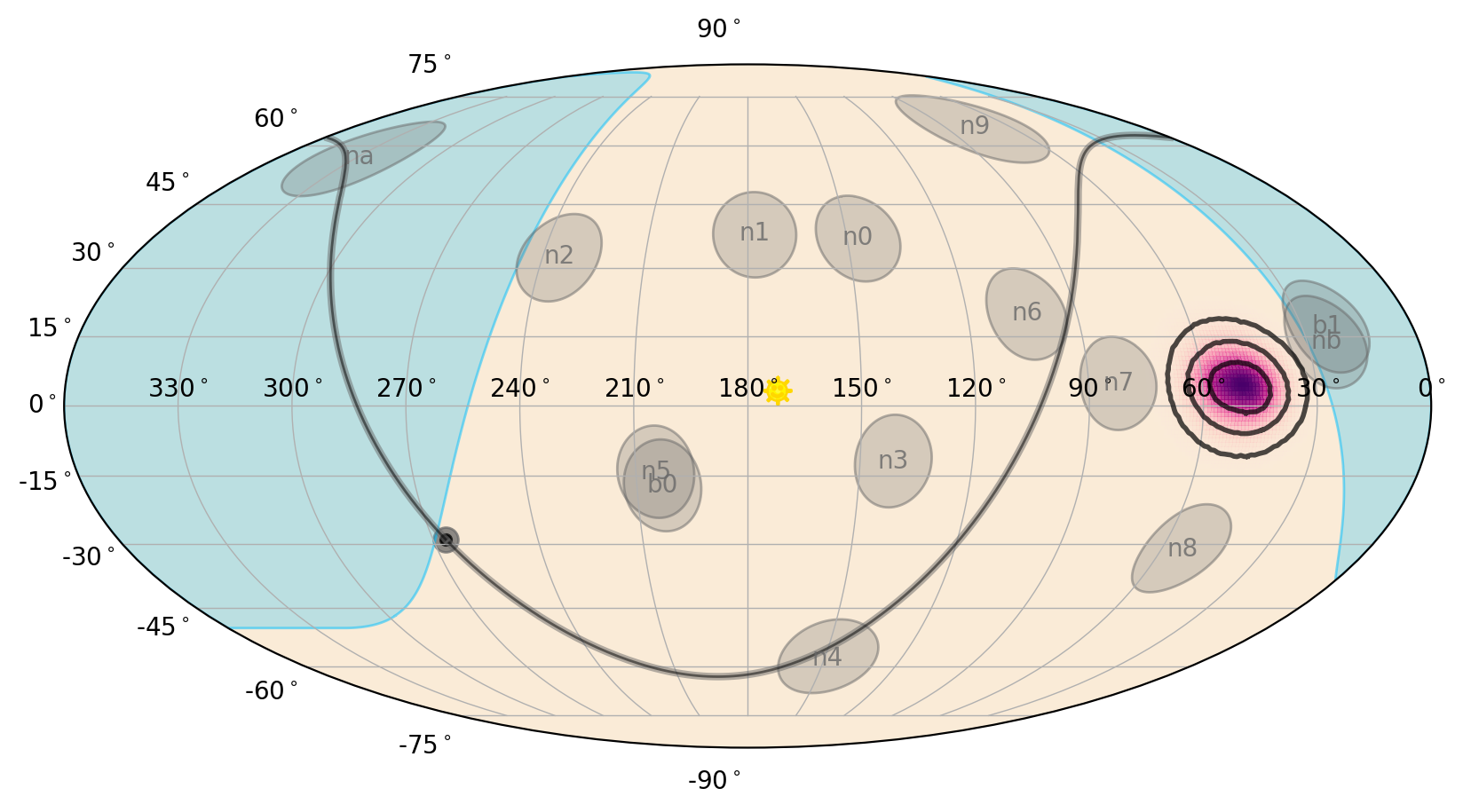
By default, the plot shows the localization (purple gradient and black contours), the Earth occultation region (blue), the detector pointings (grey circles), Galactic Plane (gray/black line), and sun (yellow smiley-face).
This is for default plotting options, but you can do a lot of customization on what is plotted (see Plotting Sky Maps, Localizations, and Wide-field Effective Area for more details).
Daughter of Locburst (DoL)
We now include a python port of the original Fortran code used by Fermi-GBM to perform the ground localizations required to create HEALPix formatted localization files. This code is known as the Daughter of Locburst (DoL) because it is based on the original Locburst algorithm from BATSE [1]. A description of the DoL method is provided in [2].
You can read more about the DoL implementation in GDT below:
References:
Reference/API
|
The localization systematic model for the Ground-Automated localization: A mixture of a 3.72 deg Gaussian (80.4% weight) and a 13.7 deg Gaussian. |
The localization systematic model for the targeted search during O3: a 2.7 deg Gaussian. |
|
|
The localization systematic model for the human-in-the loop localization: A mixture of a 4.17 deg Gaussian (91.8% weight) and a 15.3 deg Gaussian for a centroid between azimuth 292.5 - 67.5 or azimuth 112.5 - 247.5, otherwise a mixture of a 2.31 deg Gaussian (88.4% weight) and a 13.2 deg Gaussian. |
|
The localization systematic model for the RoboBA localization: A mixture of a 1.86 deg Gaussian (57.9% weight) and a 4.14 deg Gaussian for a "long" GRB, and a mixture of a 2.55 deg Gaussian (39.0% weight) and a 4.43 deg Gaussian for a "short" GRB. |
The localization systematic model for the Untargeted Search: A 5.53 deg Gaussian |
Class for GBM HEALPix localization files. |
|
|
Class for the GBM legacy internal Chi2Grid localization files/objects. |
